Ask Dr. Barb
More fun
Comment or question?
Print editions
About us
Tuesday
May282019

Companion plants for roses: Top English rosarian's A-to-V list of options

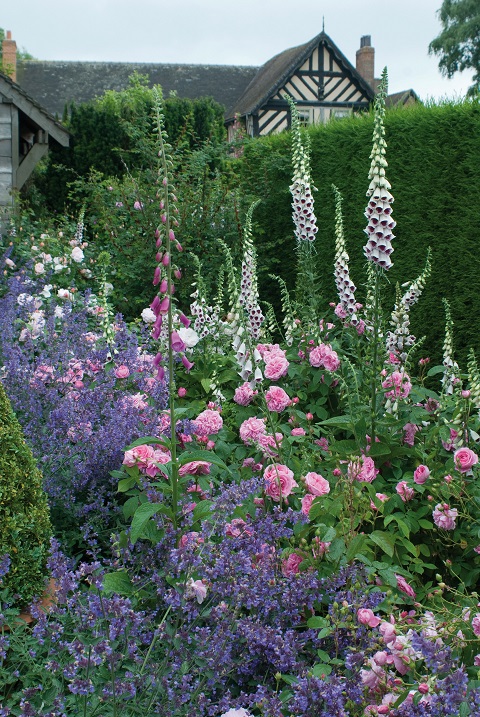
David Austin's deep pink English rose 'Gertrude Jekyll' shown with blue Nepeta (catmint) and tall maroon-throated white Digitalis 'Pam's Choice' (foxglove). 'Gertrude Jekyll,' a fragrant, repeat blooming shrub rose, grows to 5 feet tall and 3-1/2 feet wide.What to plant with roses.

It is a quandary familiar to many rose-loving gardeners, and answers can be found in the life's work of English rosarian Michael Marriott. 

As a garden designer, his life has been a literal bed of roses. He has designed rose-filled private and public gardens including the Royal Botanic Gardens Kew and Queen Mary’s Rose Garden in Regent’s Park

Marriott, senior rosarian for David Austin Roses in Albrighton, England, is known for his formal and informal planting of dense borders and beds of purely roses or roses mixed with perennials.

“The joy is in pairing flowers that play off one another, when seen side by side in full bloom," he says in a written release for David Austin English Roses. "The goal is to heighten peak bloom experiences."

As one might expect, Marriott loves roses. He delights in creating mixed borders with plant partners that enhance roses in bloom. He most often prefers sweeps of color – both complementary and contrasting – to create movement and lead the eye.

Marriott, whose suggested list of companion plants for roses follows, admits to a special fondness for the romantic informality of English roses, which he enhances by pairing them with cottage garden favorites and small-flowered plants with the look of wildflowers. His border designs feature massed plantings of like-with-like for impact and an overall calming effect.

As an organic gardener, he incorporates plants that are attractive to beneficial insects likely to devour aphids and other pests.
Click to read more ...

Friday
Feb052016

Water garden: Growing hyacinth indoors for fragrance and winter blooms

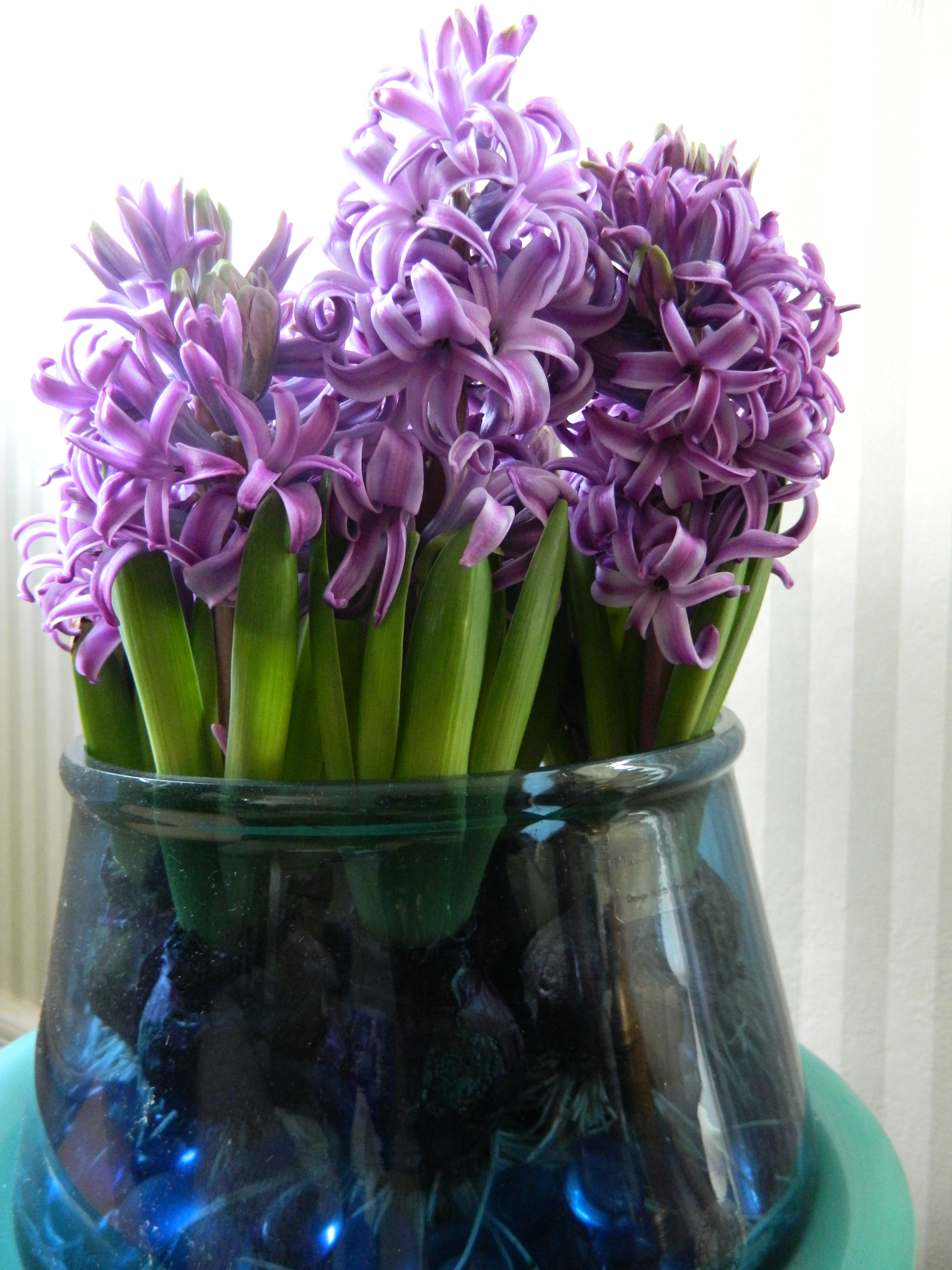
My blue bowl vase filled with fragrant hyacinths from bulbs grown on water.Spring hyacinth bulbs that I started in water weeks ago are now in full bloom in my living room.

They are filling the place with fragrance. I'm not sure if I like the fragrance, but the total sensory experience on the second snowy day this winter certainly brings a nice mood lift. It also helps that this hyacinth variety, 'Purple Sensation' is my favorite lavender.

This is the second year that I have grown spring bulbs indoors in vases with only water and marbles or stones.

The marbles or stones are placed in a vase or bowl with water added to just cover them. The bulbs are then set on top so their bottoms don't get wet. In glass vases and bowls you can see the roots grow, which makes this a fun project to enjoy with kids. Eventually, the rooted bulbs produce flowers.

The spring blulbs require a cold period, just as they'd have if they'd been properly planted outdoors in soil in the fall. 

I start the bulbs in my unheated basement, where they seem to be very happy, and then I bring them upstairs when they seem ready to flower.

So far, I've had success growing indoor flowers this way from bulbs for tulips (safe from the squirrels and the deer), amaryllis, grape hyacinth (muscari) and, this year, the full-size hyacinths shown.

There are several tulip varieties now well rooted in water in the basement, and I'll start more today to compare the difference in growth with those set on water several weeks ago.

Saturday
Jan232016

Forcing hyacinths in water: Snowy day report 

Forcing hyacinth bulbs in water. These were set in the bowl on Dec. 22 Forcing spring bulbs in water was so much fun last year that I decided to do it again.

I had not planned the blow-by-blow progress posts this year, but I shoveled 8 inches of snow (I measured) from my driveway starting at 7:13 a.m. I  finished at 8:33 just so I could go for a little drive on the Union County roads I knew would be cleared.   

Now it's 12:24, I'm back home, and the scene from my window looks like I never shoveled at all. So, here is an update on my bulbs. 

On Dec. 22, I put hyachinth bulbs on marbles in my blue bowl/vase. I put them in my unheated  basement and covered them with very loosely woven burlap cloth. Over the weeks they developed the roots shown, and grew robustly without light. Last Monday (Jan 18), I decided to bring them upstairs because their tops were already touching the burlap and some leaves had dark tips. I wasn't sure if they were being injured by the fabric, so I took it off and put them in the usual place near a sunny living room window.

They've greened up nicely. Here's what they look like on a snow-covered day.  

Hyacinths being forced in water. They are shown above with one month's growth.


Saturday
Oct312015

Indoor garden: forcing grape hyacinth (muscari) in water

Kimberly L. Jackson

My experiments with forcing spring flower bulbs in  water  began on Dec. 4, 2014 when I filled a round blue bowl-type vase about a third full with clear glass marbles, poured in enough water to cover the marbles, and set about two dozen of the small grape hyacinth (muscari) bulbs on top of them.


They were in my living room, which stays on the cooler side, between 55 to 60 degrees, as a little-used room. 


About five of the bulbs didn't sprout as quickly as the others, so I took those out and put four of them in a square vase with green marbles in the window of a sunny bedroom that was about 68 to 70 degrees on average.

Click to read more ...

Saturday
Oct312015

Indoor garden: Forcing tulip bulbs in water 

Kimberly L. Jackson

Last winter I had success with growing three types of bulbs -- tulips, grape hyacinths (muscari) and amaryllis -- in plain water.

In each case, the bulbs were supported in vases of various sizes by marbles, smooth stones or faceted acrylic gems.

I got the idea from iBulb, the Dutch flower-bulb-promoting organization, which had a picture of larger hyacinths growing on smooth stones in shallow vases. 

I decided to try it with the three types of bulbs mentioned.

What follows is a streamlined guide to my process, which was mostly experimental with some guidance from the Lakewood, New Jersey bulb supplier Longfield Gardens, which provided my bulbs.

1. PREPARE THE GROWING MEDIA


Start with clean vases and fillers. Use a weak bleach solution (2 teaspoons of bleach in a gallon of water) to clean vases and to soak all stones, marbles or other fillers for 10 minutes. Rinse well and dry.

Click to read more ...